Career Jumping
The world's most familiar video game character, Mario, has been in many professions over the years. In fact, he's been in several in just
his first few years! He began in 1981 as a carpenter that had to save his girlfriend from a stupid ape called Donkey Kong. The next year, in
the sequel Donkey Kong Jr., Mario kidnaps the ape as revenge while his titular son comes to save him. The year after that, Mario and his
brother Luigi team up as plumbers to clear turtles, crabs, and flies out of pipes in the sewers in Mario Bros. It was clear that the
brothers found their calling by then, as they've been plumbers ever since.
In 1984, development had finished for Excitebike and Devil World on the Famicom. It was then that designers Shigeru Miyamoto and Takashi
Tezuka began work on a prototype game that took place on a single-screen with a 16-by-32 pixel rectangle that didn't jump. Later, in a new
prototype, they decided to expand on the concept by using large sprites like in Devil World, eventually redesigning the rectangle to feature
Mario, citing the success of his latest arcade outing. This new sprite was considerably larger than the arcade game's, and as there was no
Super Mushroom power-up yet, this was Mario's only size, and thus the official introduction of his "super" size. He also didn't shrink when
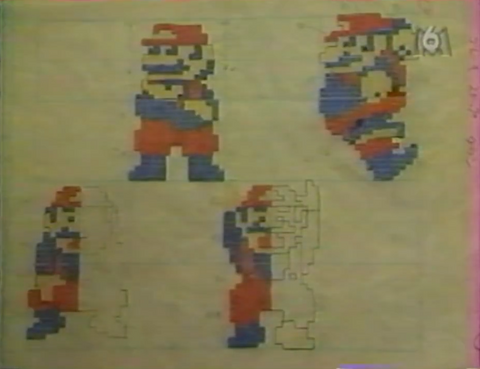
taking damage, as evidenced by these eventually-unused death sprites for what would become Super Mario:
Nintendo's Land
Taking after Excitebike, Nintendo implemented a game engine with fast scrolling backgrounds that allowed the player to walk and smoothly
increase momentum at will. This gave the game an element of strategy as they could either slowly and methodically plan out how they would
advance, or they could run and jump through long stretches of the level. Concerning multiplayer, Miyamoto planned on making the game so
that two players could play simultaneously, like Mario Bros. But likely due to technical limitations, it shifted to two-player alternating
when the screen-scrolling idea sprung up. The idea for Warp Zones also came from Excitebike, which allowed you to pick which course to
start on.
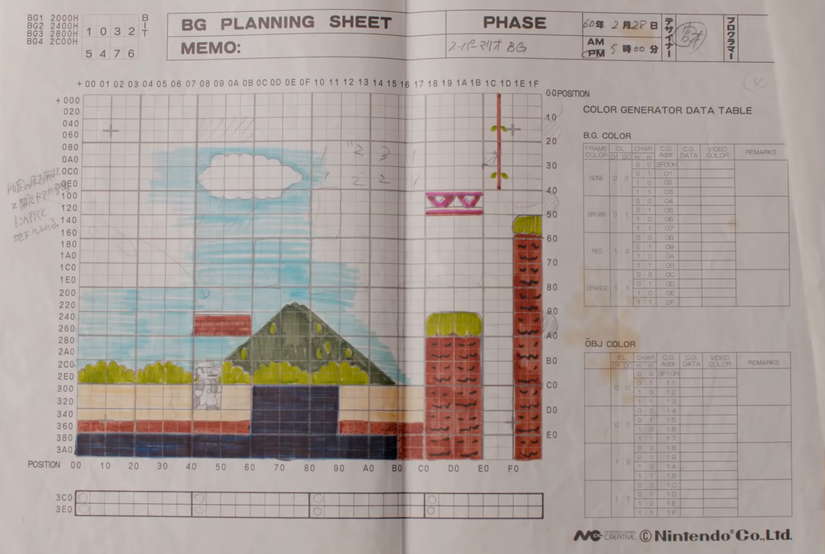
According to the sketch below, level elements from the three arcade games were to be used in Super Mario Bros. These include Donkey Kong's
conveyor belts, ladders, and girders; Donkey Kong Jr.'s ropes, logs, and springs; and Mario Bros.' frozen platforms and pipes. Eventually,
they designed new elements or included variations of each in the game to make it stand out from the rest, be more original, and fit the
levels' environments. And because of how plain Mario Bros. looked with a black background, Miyamoto decided to make it look more appealing
by changing the color for some levels to blue.
Interpid Methods
Another major area that changed dramatically throughout development was Mario's moveset and methods of attack. Early on, the game was
less about platforming and more about shooting. He would've used weapons like a rifle and a beam gun while riding a rocket. Later on, he
was put on a cloud, as evidenced by this sketch:
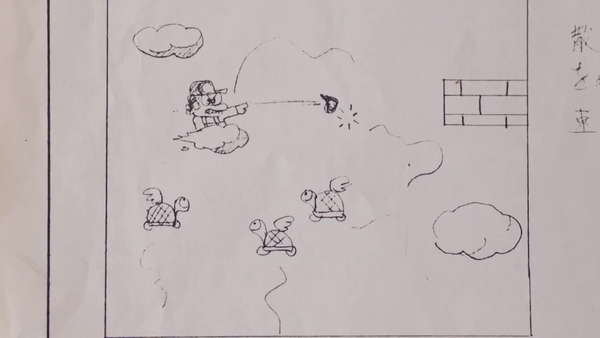
Miyamoto's original plan was to design levels with mechanics depending on their settings, such as on the ground, in the water, and in the
air. Having Mario fly around on a cloud in the sky levels was one example. The controls originally involved Up to jump and A to use an
item in hand or kick if empty. Due to technical limitations and difficulties, this never came to pass. However, sky levels remained as
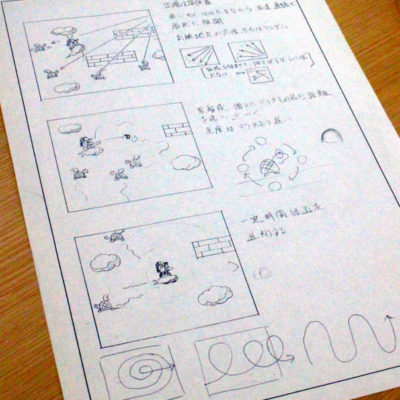
places for Mario to collect coins when he climbs up a vine. Even more interesting is the spiral, sinewave, and loop-de-loop that was
drawn at the bottom of the page. I think this was a concept for auto-scrolling levels that required you to stay on a platform that moved
along the drawn path. This didn't come to fruition until Super Mario Bros. 3 in 1988.
A Byte Saved is a Byte Earned
Miyamoto instructed Systems Research and Development to create levels that would last about a minute, citing that it takes about a second
for Mario to run from one side of the screen to the other. SRD originally thought that meant making levels 60 "screen-lengths" long, but
Miyamoto explained that there had to be some obstacles to slow the player down. This greatly shortened the levels down to 12 to 32
screens, but did save memory for more levels.
Speaking of, this was a common issue that the team ran into during development: the amount of memory. They had to reuse certain graphics
and sounds wherever necessary to conserve space for other things. That's why, for instance, bushes and clouds use the same graphics, the
only differences being the colors and placement on the screen. And when you take damage and go down a pipe, the sounds are the same. At
the end of development, with the small amount of memory that remained, Miyamoto implemented a crown graphic that appears when the player
accumulates over 10 lives. This feature was reused in several Mario games thereafter.
A Super Power
In February 1985, the team finally implemented the world-renowned Super Mushroom, which spurred the game's name Super Mario Bros. They
designed the levels to be completed by regular-sized "Small Mario", but felt it would be more exciting if Mario could grow using this new
power-up. According to Miyamoto, the inclusion of the Super Mushroom was inspired by Japanese folklore where people eat magic mushrooms
they find in a forest. This actually spurred the game world's name, Mushroom Kingdom. The idea was when the mushroom is freed from a ?
Block, it moves. It was programmed to move slightly slower than Mario's max speed in the opposite direction to make it exciting to chase
after. But it occurred to the team that when freeing something that resembles a Goomba from a ? Block, an inexperienced player's first
reaction would be to run away from it. If a player were to try jumping over a Goomba to avoid it, they'd land on it and kill it. This
would reinforce someone playing for the first time that the mushrooms are to be collected, and the Goombas are to be jumped on or avoided.
Music Moment
Of course, one of the most memorable features of Super Mario Bros. was the catchy music. Composer Koji Kondo worked with the other
developers as they made the game to figure out what kind of music to create for each category of levels. The first tune he composed for
the game was the underwater theme, which may have been first because it was the easiest to find a melody. He had three goals to attain
with his game music: To make the game experience emotionally and physically captivating for the player; For the graphics and animations of
enemies and obstacles to match the music; And for it to "heighten the feeling" of the controls. Composers of video games by this point
rarely made these considerations. As development went on, Kondo simply sped up the songs to fit the action better. It would also be
adjusted at the request of playtesters.
Release
Super Mario Bros. made its groundbreaking debut on September 13, 1985 in Japan.